


Parashat Vayechi – Year 3 – The Death of Jacob in Egypt.
Shabbat Shalom, Nazarene family.
This week we will study the parashat Vayechi, portion of year 3, where we will see how Jacob finishes blessing his sons and gives instructions for his burial, asking to be buried alongside his ancestors. We will learn about Joseph’s deep sorrow as he bids farewell to his father and how he honors his will. We will read how, after Jacob’s death, Joseph’s brothers fear that he will seek revenge, but he responds with compassion and forgiveness. We will also see how Joseph lives out his final years in Egypt trusting in Yahweh’s promises. This portion teaches us about honor, forgiveness, and faith in the future.
B’reisheet (Genesis) 49:33-50:1
33 And when Jacob had finished commanding his sons, he drew his feet up into the bed and breathed his last, and was gathered to his people.
1 Then Joseph fell on his father’s face and wept over him, and kissed him.
This week corresponds to the reading of the texts (in bold):
- B’reisheet (Genesis) 47:28-48:22 / 49:1-16 / 49:27-50:26
- Melachim Aleph (1 Kings) 2:1-9 / 2:10-35 / 2:36-46
- Luqa (Luke) 4:31-37 / 4:38-44 / 5:1-11
Summary of the weekly study, Year three:
B’reisheet (Genesis) 49:27-50:26
In these verses, Jacob gives his last words to each of his sons and asks to be buried in the Promised Land. His death marks the end of an era, but also the affirmation of Yahweh’s promises. Joseph shows a heart full of forgiveness as he comforts his brothers who fear his vengeance. Then, before he dies, he reaffirms that Yahweh will visit His people and bring them out of Egypt. In this passage, we learn that the legacy of faith, family honor, and forgiveness paves the way for the redemption that is to come.
Melachim Aleph (1 Kings) 2:36-46
In these verses, King Solomon tests Shimei, ordering him not to leave Jerusalem on pain of death. Shimei agrees, but later disobeys, leaving to search for some servants. When the king finds out, he remembers Shimei’s past evil deeds and carries out the sentence he had warned him about. Solomon’s justice is affirmed, and his kingdom is strengthened by eliminating internal threats. In this passage, we learn that obedience has consequences, and that Yahweh gives wisdom to those who govern to establish peace, justice, and order among the people.
Luqa (Luke) 5:1-11
In these verses, Yeshua encounters fishermen who have been unable to catch anything. He asks them to cast their nets again, and although they hesitate, they obey… and a miracle occurs: the nets are filled. Shimón Kefa (Peter), seeing this, recognizes himself as a sinner in the presence of the Messiah. Yeshua encourages him and reveals that he will now be a “fisher of men.” They leave everything behind and follow him. In this passage, we learn that when we obey Yeshua’s voice, even in everyday life, we can see wonders, and we are called to a life of greater purpose with him.
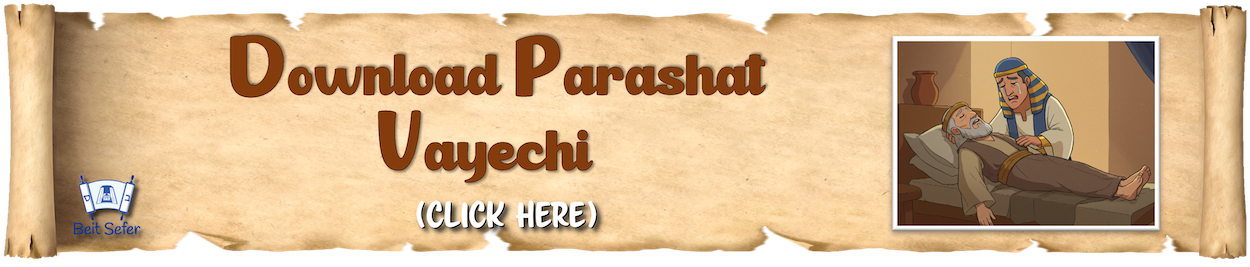
–
Enjoy this fun activity with the whole family. Inside you will find development questions for the three weekly sections (Torah, Haftarah and Brit Chadasha). While the older ones discuss the questions and their answers, the younger ones can color the picture related to the teaching, solve a maze, find the 7 differences and much more. We encourage you to do it week by week and instill in your children the habit of studying Yahweh’s word as a family.
We hope you and especially your sons and daughters enjoy this effort. For it is through the study of the Scriptures that we can come to understand the love and care that Yahweh has always had for us. And also to perceive that He has been taking care of even the smallest detail, so that we can take care and enjoy all that He gives us. That is why it is so important that our children learn and grow up knowing that they are loved by the Creator of all that exists.
Shalom.
To view the Tanach studies, click here

