


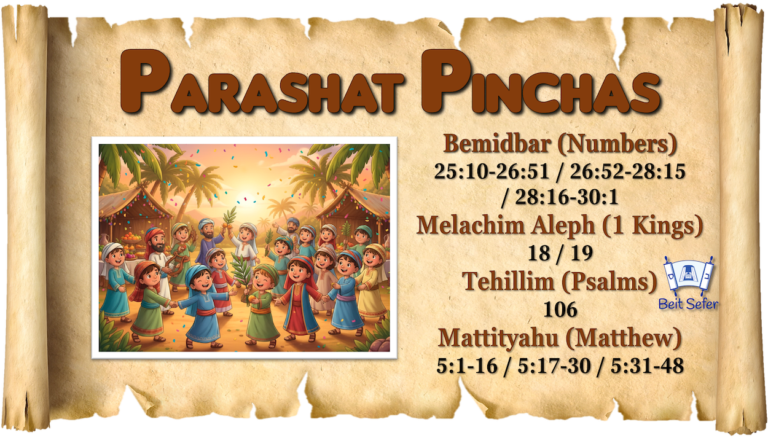
Parashat Pinchas – Year 3 – Feast and Joy in Yahweh.
Shabbat Shalom, Nazarene family.
This week we will study the parashat Pinchas, portion of year 3, we will see the detailed instructions that Yahweh gave to Moshe regarding the set-apart feasts and the specific sacrifices for each occasion. We will read about the importance of Pesach, the Feast of Weeks, and the celebrations of the seventh month, including the Day of Atonement. We will learn how each offering was to be presented before Elohim with order and devotion, reinforcing the spiritual commitment of the people. Finally, we will understand the seriousness of vows and promises made before Yahweh, reminding us that our word and our worship must be treated with absolute integrity and respect.
Bemidbar (Numbers) 29:39
39 ‘These you shall present to Yahweh at your appointed feasts (besides your vowed offerings and your freewill offerings) as your burnt offerings and your grain offerings, as your drink offerings and your peace offerings.’ “
This week corresponds to the reading of the texts (in bold):
- Bemidbar (Numbers) 25:10-26:51 / 26:52-28:15 / 28:16-30:1
- Melachim Aleph (1 Kings) 18 / 19
- Tehillim (Psalms) 106
- Mattityahu (Matthew) 5:1-16 / 5:17-30 / 5:31-48
Summary of the weekly study, Year three:
Bemidbar (Numbers) 28:16-30:1
In these verses, we see how Yahweh establishes a sacred calendar of worship and commitment for His people. Through the description of various feasts and sacrifices, the importance of maintaining a constant, orderly, and dedicated relationship with the divine throughout the year is emphasized. It is not just a matter of isolated rituals, but of a lifestyle that recognizes Elohim’s sovereignty in every season. The central teaching lies in faithfulness and personal responsibility to the promises made. In this passage, we learn that our devotion requires discipline, order, and total integrity.
Tehillim (Psalms) 106
In these verses, we trace the history of Israel as a mirror of Yahweh’s mercy in the face of constant human weakness. The text shows us a repetitive cycle in which the people forget the wonders they have received, fall into disobedience, and suffer the consequences of their actions, only to be rescued by Elohim’s compassion. It highlights that, despite ingratitude and mistakes, faithfulness to the divine covenant prevails when there is sincere repentance. In this passage, we learn that Yahweh’s goodness is infinite and always ready to forgive us.
Mattityahu (Matthew) 5:31-48
In these verses, we hear Yeshua raising the standard of conduct for those who follow Yahweh, delving into the true spirit of the law. The message focuses on transforming the heart beyond outward obedience, addressing issues such as integrity in marriage, absolute honesty in our words, and peaceful response to aggression. We are invited to break the cycle of hatred by showing generous love even to those who consider us enemies. In this passage, we learn that the goal of the believer is to reflect the perfection and unconditional love that characterizes Elohim.
–
Enjoy this fun activity with the whole family. Inside you will find development questions for the three weekly sections (Torah, Haftarah and Brit Chadasha). While the older ones discuss the questions and their answers, the younger ones can color the picture related to the teaching, solve a maze, find the 7 differences and much more. We encourage you to do it week by week and instill in your children the habit of studying Yahweh’s word as a family.
We hope you and especially your sons and daughters enjoy this effort. For it is through the study of the Scriptures that we can come to understand the love and care that Yahweh has always had for us. And also to perceive that He has been taking care of even the smallest detail, so that we can take care and enjoy all that He gives us. That is why it is so important that our children learn and grow up knowing that they are loved by the Creator of all that exists.
Shalom.
To view the Tanach studies, click here

