


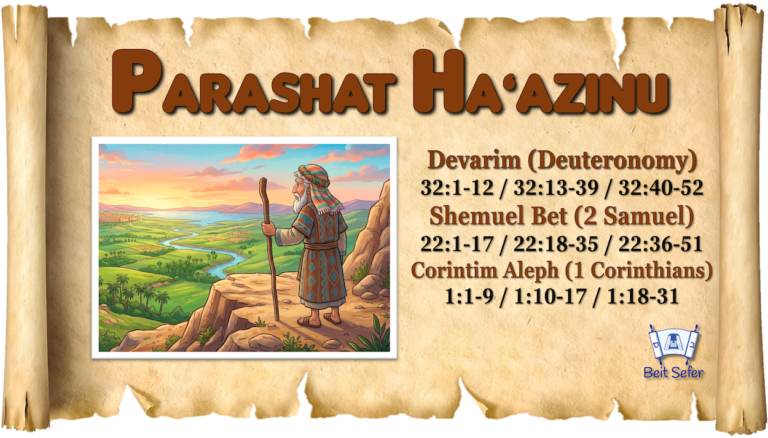
Parashat Ha’azinu – Year 3 – The Importance of Obedying.
Shabbat Shalom, Nazarene family.
This week we will study the parashat Ha’azinu, portion of year 3, where we will see how Yahweh raises His hand to heaven and promises justice for His people. We will learn that His word is life for us and that we must teach it to our children with great care. We will read about Elohim’s invitation to Moses to ascend Mount Nebo. We will see that he will be able to view the Promised Land from afar before departing. We will learn that obeying Yahweh is the most important thing in our daily walk. In these pages, we will read about the conclusion of Moses’ mission under His guidance and His great, everlasting love today.
Devarim (Deuteronomy) 32:51-52
51 because you trespassed against Me among the children of Israel at the waters of Meribah Kadesh, in the Wilderness of Zin, because you did not hallow Me in the midst of the children of Israel.
52 Yet you shall see the land before you,though you shall not go there, into the land which I am giving to the children of Israel.”
This week corresponds to the reading of the texts (in bold):
- Devarim (Deuteronomy) 32:1-12 / 32:13-39 / 32:40-52
- Shemuel Bet (2 Samuel) 22:1-17 / 22:18-35 / 22:36-51
- Corintim Aleph (1 Corinthians) 1:1-9 / 1:10-17 / 1:18-31
Summary of the weekly study, Year three:
Devarim (Deuteronomy) 32:40-52
In these verses, we contemplate Yahweh’s sovereignty and His promise of justice for all His faithful children. He reminds us that His word is not empty, but represents our very lives and the security of our future on earth. We must teach these commandments to our children with great dedication so that they too may walk under His constant guidance. Although Moses must ascend Mount Nebo to rest, Elohim’s faithfulness remains steadfast for the new generations who will enter the promise. His love always watches over us. In this passage, we learn that His word is life.
Shemuel Bet (2 Samuel) 22:36-51
In these verses, we see the gratitude of a heart that acknowledges Yahweh as its shield and constant protector. Elohim strengthens our hands to face any battle and widens the path we walk so that our steps do not slip. By trusting fully in His power, we receive victory over the obstacles and enemies that try to stop us. His faithfulness is like a firm rock that never moves, bringing salvation to His king and all His descendants forever. Praising His name is our daily strength. In this passage, we learn that His strength causes us to triumph with great joy.
Corintim Aleph (1 Corinthians) 1:18-31
In these verses, we understand that Yeshua’s message seems like folly to the world, but to us it is His great saving power. Elohim chose to set aside human wisdom to show that His understanding is infinitely superior. He chose the humble and weak to put the powerful to shame, ensuring that no one may boast in His divine presence. Yeshua becomes our wisdom, righteousness, sanctification, and eternal redemption by His grace. All that we are comes from His love, so that whoever boasts may do so only in Yahweh. In this passage, we learn that His wisdom surpasses all human understanding.

–
Enjoy this fun activity with the whole family. Inside you will find development questions for the three weekly sections (Torah, Haftarah and Brit Chadasha). While the older ones discuss the questions and their answers, the little ones can put together a puzzle related to the lesson, solve a maze, find the 7 differences and much more. We encourage you to do it week by week and instill in your children the habit of studying Yahweh’s word as a family.
We hope you and especially your sons and daughters enjoy this effort. For it is through the study of the Scriptures that we can come to understand the love and care that Yahweh has always had for us. And also to perceive that He has been taking care of even the smallest detail, so that we can take care and enjoy all that He gives us. That is why it is so important that our children learn and grow up knowing that they are loved by the Creator of all that exists.
Shalom.
To view the Tanach studies, click here

