


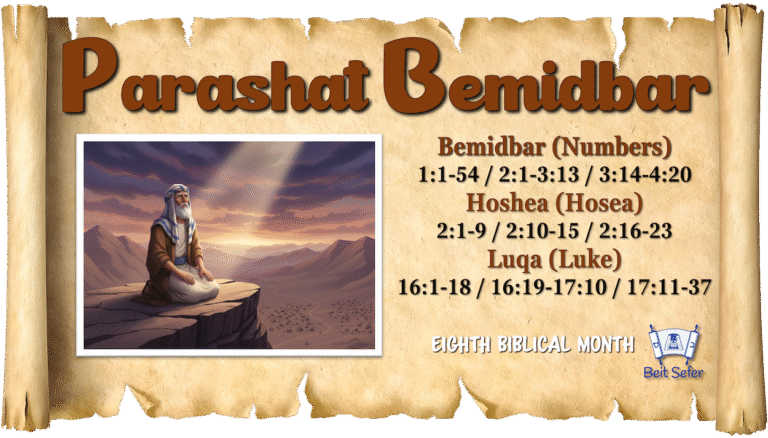
Parashat Bemidbar – Year 3 – Instructions From The Mountain.
Shabbat Shalom, Nazarene family.
This week we will study the parashat Bemidbar, portion of year 3, where we will see how Yahweh organizes the Levites and assigns them special tasks to care for the Tabernacle. We will learn that each Levite family has a different function and that their service is very important for maintaining order and set-apartness in the camp. We will read how sacred objects must be prepared and moved when the people travel, and how only certain Levites can approach them to avoid danger. In summary, we will see the value of obedience, order, and respect for what Yahweh considers set-apart.
Bemidbar (Numbers) 3:14-16
14 Then Yahweh spoke to Moshe in the Wilderness of Sinai, saying:
15 “Number the children of Levi by their fathers’ houses, by their families; you shall number every male from a month old and above.”
16 So Moshe numbered them according to the word of Yahweh, as he was commanded.
This week corresponds to the reading of the texts (in bold):
- Bemidbar (Numbers) 1:1-54 / 2:1-3:13 / 3:14-4:20
- Hoshea (Hosea) 2:1-9 / 2:10-15 / 2:16-23
- Luqa (Luka) 16:1-18 / 16:19-17:10 / 17:11-37
Summary of the weekly study, Year three:
Bemidbar (Numbers) 3:14-4:20
In these verses, Yahweh establishes the special role of the Levites as those responsible for caring for and transporting everything related to the Tabernacle. Each Levite family is given specific tasks, showing that service to Yahweh requires order, respect, and obedience. The importance of protecting what is set-apart and following instructions carefully is emphasized, as any carelessness could have serious consequences. We also see that spiritual responsibility is a privilege that involves reverence and commitment. In this passage, we learn that serving Yahweh must be done with obedience, order, and deep respect for His Set-apartness.
Hoshea (Hosea) 2:16-23
In these verses, Yahweh promises to restore His relationship with His people with tenderness and love. We will see how He transforms punishment into hope, speaking affectionately to those who had previously strayed. We will learn that Yahweh removes the names of the false elohim and renews a covenant based on faithfulness, compassion, and justice. We will also read how the land bears fruit again and His people are once more called “My people,” and He responds to them with love. In this passage, we learn that Yahweh always seeks to restore and heal His relationship with those who belong to Him.
Luqa (Luke) 17:11-37
In these verses, we will see how Yeshua heals ten lepers, but only one—a Samaritan—returns to thank Him, showing that true faith is recognized in gratitude. We will learn that the Kingdom of Yahweh does not come with visible signs, but is among those who follow Yeshua. We will also read that He warns about the end times, comparing them to the days of Noah and Lot, when people lived without realizing the danger. In this passage, we learn that we must live with faith, gratitude, and attentiveness, ready for when Yeshua manifests Himself again.
–
Enjoy this fun activity with the whole family. Inside you will find development questions for the three weekly sections (Torah, Haftarah and Brit Chadasha). While the older ones discuss the questions and their answers, the younger ones can color the picture related to the teaching, solve a maze, find the 7 differences and much more. We encourage you to do it week by week and instill in your children the habit of studying Yahweh’s word as a family.
We hope you and especially your sons and daughters enjoy this effort. For it is through the study of the Scriptures that we can come to understand the love and care that Yahweh has always had for us. And also to perceive that He has been taking care of even the smallest detail, so that we can take care and enjoy all that He gives us. That is why it is so important that our children learn and grow up knowing that they are loved by the Creator of all that exists.
Shalom.
To view the Tanach studies, click here

