


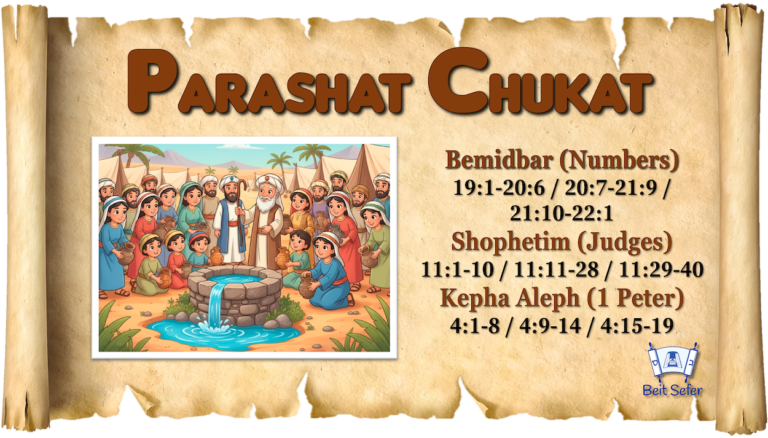
Parashat Chukat – Year 3 – The Well Of Provision.
Shabbat Shalom, Nazarene family.
This week we will study the parashat Chukat, portion of year 3, where we will see how Israel travels through the desert, passing through various places as it approaches the Promised Land. We will learn that, even in the midst of exhaustion and uncertainty, Yahweh guides every step and shows His care in unexpected ways. We will also read how a well becomes a source of joy, reminding us that provision can appear just when it seems that there is no strength left. We will also see that neighboring peoples observe these movements, setting the stage for new challenges in the history of the people on their long and challenging daily journey.
Bemidbar (Numbers) 21:17-18
17 Then Israel sang this song: “Spring up, O well! All of you sing to it—
18 The well the leaders sank, Dug by the nation’s nobles, By the lawgiver, with their staves.” And from the wilderness they went to Mattanah,
This week corresponds to the reading of the texts (in bold):
- Bemidbar (Numbers) 19:1-20:6 / 20:7-21:9 / 21:10-22:1
- Shophetim (Judges) 11:1-10 / 11:11-28 / 11:29-40
- Kepha Aleph (1 Peter) 4:1-8 / 4:9-14 / 4:15-19
Summary of the weekly study, Year three:
Bemidbar (Numbers) 21:10-22:1
In these verses, the people of Israel continue their journey through the desert while learning to depend fully on Yahweh at every stage of the journey. Amidst weariness and uncertainty, they receive moments of encouragement that remind them that His care is never lacking. They also discover that provision can appear in the most unexpected places, strengthening their confidence to keep moving forward. The main teaching highlights that faith is practiced step by step, even when the road seems difficult. In this passage, we learn that Yahweh’s constant guidance sustains the heart and renews hope each new day.
Shophetim (Judges) 11:29-40
In these verses, we see Jephthah facing a serious decision as he seeks Yahweh’s help in overcoming a major challenge. Throughout the story, we understand how rash promises can bring pain and difficult consequences. The story shows the importance of acting wisely and carefully considering our words before committing to them. It also reflects how impulsive decisions can affect those we love. The main lesson invites us to reflect on personal responsibility and prudence. In this passage, we learn that spiritual maturity requires thinking before speaking and acting with integrity in every situation.
Kepha Aleph (1 Peter) 4:15-19
In these verses, we are encouraged to maintain righteous conduct, avoiding actions that bring suffering due to our own mistakes. It is emphasized that if we face difficulties for doing what is right, we should not be ashamed, but trust in Yahweh, who observes every intention. We are also reminded that judgment begins with those who follow His way, inviting us to live with seriousness, humility, and perseverance. The central teaching shows that purposeful suffering strengthens faith and reveals a sincere heart. In this passage, we learn that trusting in Yahweh in the midst of adversity produces steadfastness, inner peace, and renewed hope each day.
–
Enjoy this fun activity with the whole family. Inside you will find development questions for the three weekly sections (Torah, Haftarah and Brit Chadasha). While the older ones discuss the questions and their answers, the younger ones can color the picture related to the teaching, solve a maze, find the 7 differences and much more. We encourage you to do it week by week and instill in your children the habit of studying Yahweh’s word as a family.
We hope you and especially your sons and daughters enjoy this effort. For it is through the study of the Scriptures that we can come to understand the love and care that Yahweh has always had for us. And also to perceive that He has been taking care of even the smallest detail, so that we can take care and enjoy all that He gives us. That is why it is so important that our children learn and grow up knowing that they are loved by the Creator of all that exists.
Shalom.
To view the Tanach studies, click here

